Robozonex
Loading page content...
Loading page content...
Discover in-depth robotics tutorials, hardware build logs, system architecture updates, and industry insights from our team.
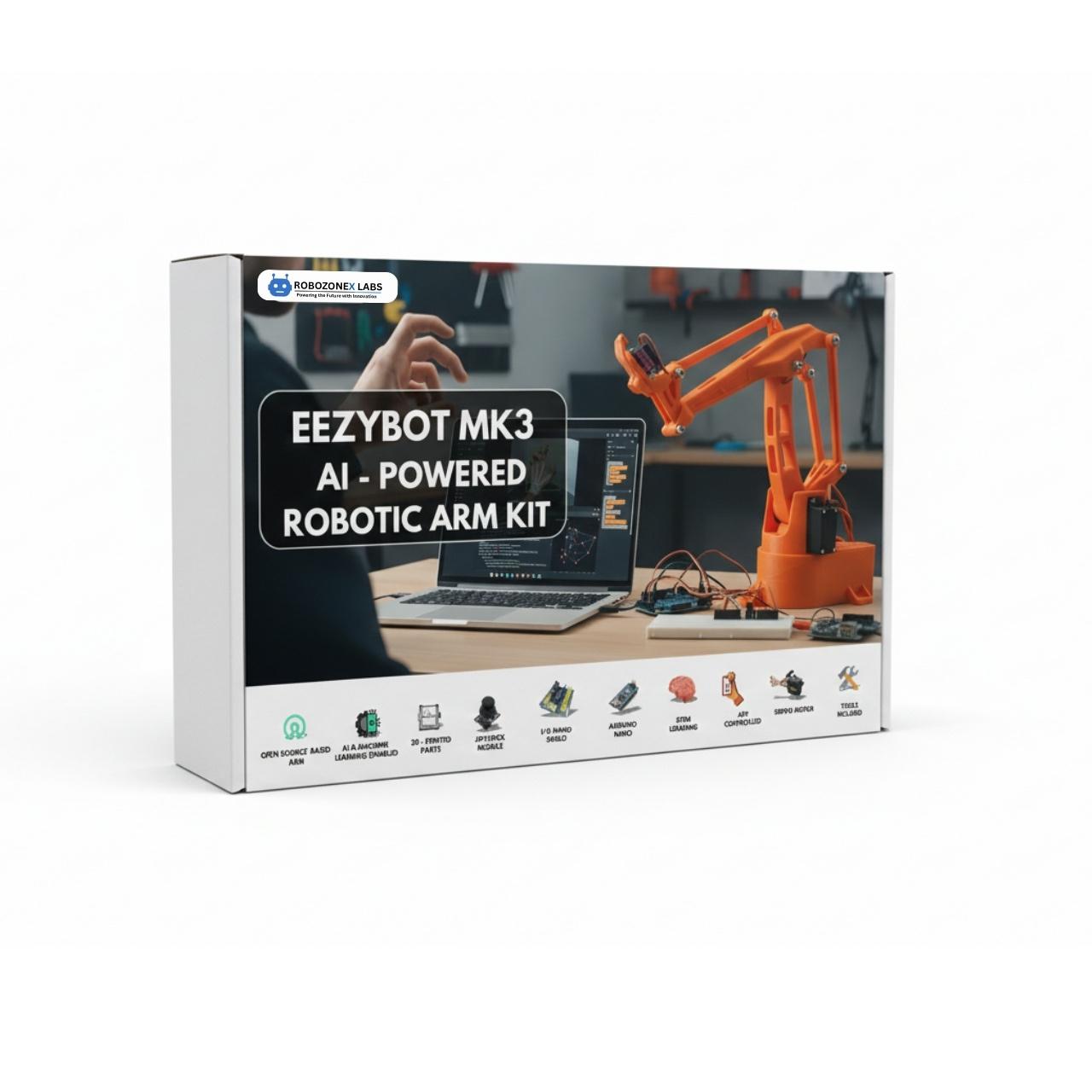
Forward vs. Inverse Kinematics: The Core Challenge In industrial robotics and automation, moving a robotic arm's end-effector (gripper) to a specific target point in space (X, Y, Z) is known as Inverse Kinematics (IK). - Forward Kinematics (FK): Given the servo joint angles (\theta1, \theta2, \theta3), calculate where the gripper is positioned (X, Y, Z). (Mathematically simple matrix multiplication). - Inverse Kinematics (IK): Given a desired physical object position (X, Y, Z), calculate the exact servo angles (\theta1, \theta2, \theta3) needed to reach it. (Requires trigonometric geometric solving or iterative Jacobian matrices). The RoboZoneX EEZYBOT-MK3 AI Robotic Arm Kit provides a rigid, 3D-printable parallel linkage design engineered specifically to make these equations intuitive to learn. --- Solving the Geometric 3-DOF Inverse Kinematics For a 3-axis articulated robotic arm with base rotation (\theta1), shoulder joint (\theta2), and elbow joint (\theta3): 1. Base Angle (Yaw) The base servo rotates around the vertical Z-axis to face the target coordinates (X, Y): $$\theta1 = \text{atan2}(Y, X)$$ 2. Planar Projection & Arm Reach Calculate the horizontal distanc...