Robozonex
Loading page content...
Loading page content...
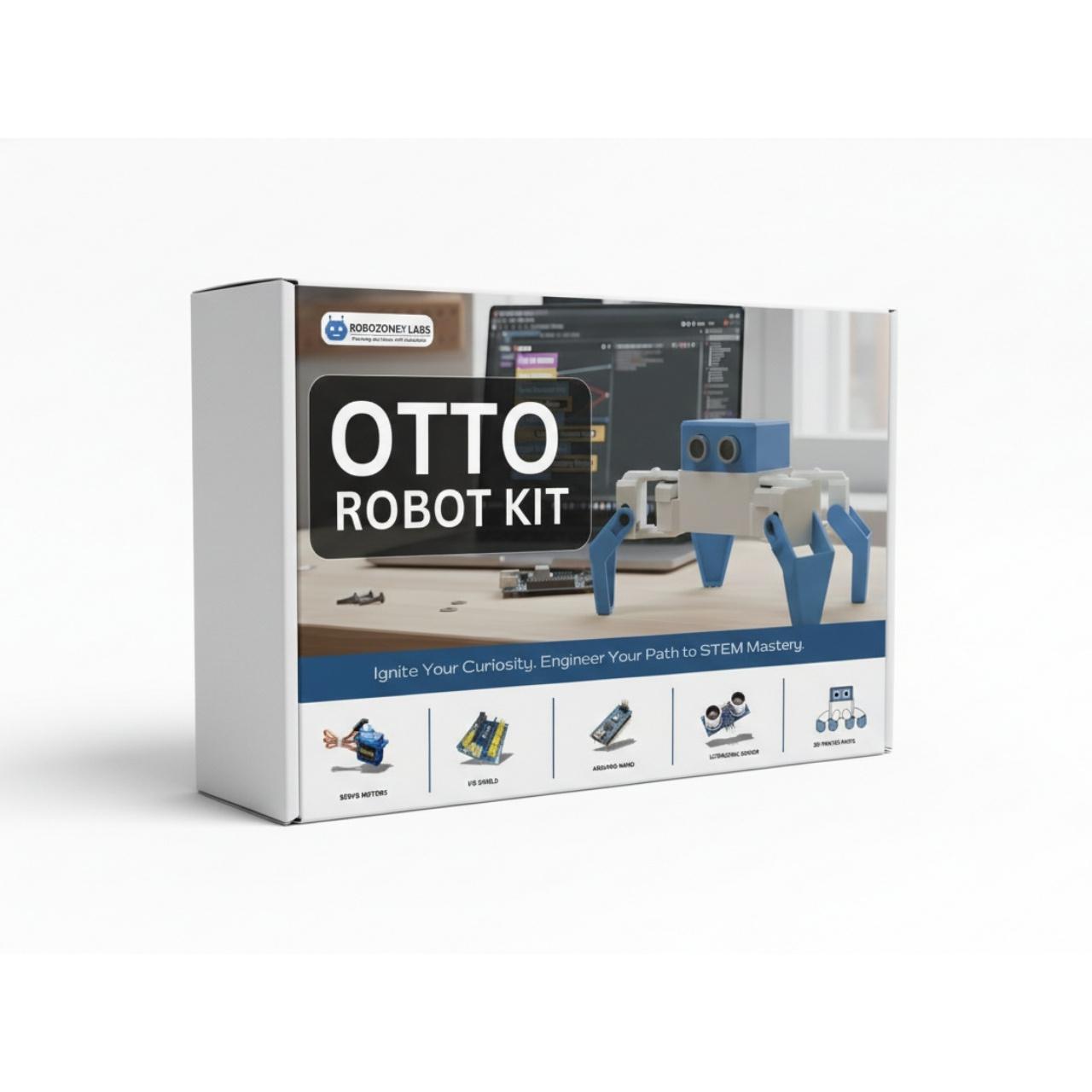
Introduction: The Mechanics of Open-Source Bipedal Locomotion Two-legged (bipedal) walking is one of the most challenging kinematics problems in educational robotics. Unlike wheeled mobile robots that maintain continuous static stability, bipedal companions like the RoboZoneX Otto Robot Kit rely on alternating dynamic center-of-mass balancing across two feet and four degrees of freedom (4-DOF). In this tutorial, we will break down the hardware architecture, servo zero-point calibration, walking gait mathematical models, and non-blocking sensor routines required to build an autonomous obstacle-avoiding bipedal robot from scratch. --- Hardware Architecture & Kinematic Chain The Otto bipedal platform utilizes four micro-servo actuators: 1. Left Leg Servo (Roll/Pitch Axis): Controls foot lift and lateral weight shifting. 2. Right Leg Servo (Roll/Pitch Axis): Coordinates weight transfer to the opposite foot. 3. Left Foot Servo (Yaw Axis): Drives forward/backward step strides. 4. Right Foot Servo (Yaw Axis): Completes the alternating stride cycle. Crucial Assembly Step: Servo Trimming & Center Pulse Before mounting the 3D-printed chassis horns, every servo must be electrically...